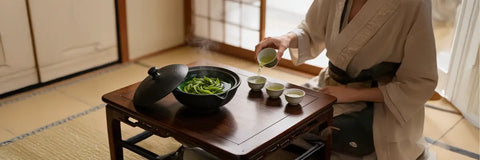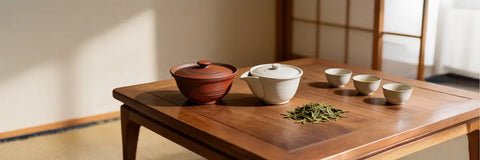
In a shiboridashi vs houhin comparison, the shiboridashi is best for highly concentrated gyokuro brewing, while the houhin is better for versatile brewing of both sencha and gyokuro in larger volumes.
Both teapots are handleless, both are built for premium green teas, and both sit well outside the world of everyday kyusu brewing, a space covered in detail in the ultimate guide to Japanese teapots.
The shiboridashi is purpose-built for gyokuro at its most concentrated, while the houhin is a more versatile vessel that handles premium sencha just as comfortably.
Understanding the differences in size, shape, filter design, and pouring technique will help you make a confident choice when weighing a shiboridashi vs houhin.
Read on for a point-by-point breakdown of every meaningful difference between these two teapots.
Shiboridashi vs Houhin: Gyokuro Specialisation vs Brewing Versatility

The main difference in a shiboridashi vs houhin comparison is that a shiboridashi is designed for highly concentrated gyokuro brewing in very small volumes, while a houhin is built to handle both gyokuro and premium sencha with greater flexibility and larger water capacity.
The shiboridashi takes its name from the Japanese verb meaning to squeeze out.
It is built for very small, dense infusions of high-grade gyokuro, producing perhaps 50 to 70ml of intensely concentrated tea per pour.
It is teaware for special occasions, not a daily routine.
The houhin translates as treasure bottle. It holds considerably more water, typically 150 to 200ml, and is designed for premium sencha and gyokuro alike.
It sits closer to the role of an everyday premium teapot, especially for those who have not yet added a kyusu to their collection.
Core Differences: Shiboridashi vs Houhin
Why Size Is the Most Practical Difference

Water capacity separates these two teapots more clearly than anything else. A shiboridashi typically holds between 50 and 70ml, whereas a houhin can easily reach 150 to 200ml.
That difference matters practically. If you want to brew a full cup of tea, a shiboridashi simply cannot do it in a single pour; it was never designed to. Instead, the shiboridashi is built to produce a small, impossibly rich shot of gyokuro, the kind you sip slowly from a tiny tasting cup rather than drink from a standard mug. The houhin, with its greater volume, gives you the flexibility to brew for more than one person or to produce a proper, full cup without needing to re-steep immediately.
The Flat, Wide Design of the Shiboridashi
The shiboridashi features a broad, shallow profile that gives tea leaves ample horizontal space to expand. When brewing very small quantities, this allows the leaves to lie completely submerged without stacking on top of one another.
The flat body also means the vessel loses heat faster than a deeper teapot, which turns out to be a distinct advantage for brewing gyokuro. The low temperatures required for this tea, often between 50 and 60°C, are much easier to maintain when the vessel itself is not retaining excess warmth.
The Deeper, Upright Profile of the Houhin
In contrast, the houhin has a more upright shape that gives expanding leaves vertical room. When a larger quantity of leaves opens up during steeping, they can rise naturally inside the vessel without pressing tightly against each other, which supports a much more even extraction.
This deeper body also retains heat more effectively. This thermal retention perfectly suits teas like sencha, which are typically brewed at slightly higher temperatures, usually around 60 to 70°C.
Understanding Filter Design in the Shiboridashi and Houhin
The Houhin Uses a Clay Mesh Filter
The houhin features a proper clay mesh filter positioned just before the spout. As you tilt the teapot to pour, the filter separates the leaves from the liquor automatically. This is the same approach used in a kyusu, and it works cleanly without relying on any metal that could influence the taste of the tea, unlike cast iron teapots, which are built from entirely different materials and serve a different brewing purpose.
If you tend to use a variety of leaf sizes or brew teas with smaller broken leaves, the houhin's built-in mesh gives you consistent, sediment-free results with no extra effort.
The Shiboridashi Relies on a Minimalist Notch Filter
When comparing the shiboridashi vs houhin, the shiboridashi takes a far simpler approach to filtration. Look at the base of the teapot and you will find three small notches carved into the clay. These notches allow water to flow through while holding back the larger leaves that gyokuro and kabuse sencha typically use.
Because these teas have full, unfurled leaves, the minimalist filter is enough. The design has very few hidden corners, which also makes cleaning effortless. Some shiboridashi models, including those available in the Nio Teas teaware collection, include a secondary filter built into the lid, giving you an additional option if you find smaller fragments are passing through. Not all kyusu follow the traditional form; some take a completely different approach to shape and pour. 👉 Origami Kyusu Teapot Folding Guide
Grip and Pouring Techniques for Shiboridashi and Houhin
The Shiboridashi Four-Finger Base Grip
The wide, flat base of the shiboridashi gives you plenty of surface area to work with. You rest four fingers across the bottom and use your thumb to secure the bump on the top of the lid. Because you are using such low-temperature water, the base stays manageable even with direct contact.
This grip is stable and intuitive once you have practised it a few times. The broad surface means you are less likely to lose control during a slow, deliberate pour.
The Houhin Three-Point Contact Pour
The houhin's deeper, rounder body means you cannot get the same flat-base grip. Instead, you use three points of contact: one finger on each side of the teapot and a finger or knuckle resting on the top. Some houhin models have two small bumps on the sides to make this easier and to reduce the chance of scalding your fingers.
This is similar in principle to how you would hold a gaiwan, another handleless teaware vessel with comparable design logic. If you are familiar with gaiwan brewing, the houhin will feel natural almost immediately.
How to Brew with a Shiboridashi and a Houhin
Brewing with the Shiboridashi

Spread about 5 grams of gyokuro leaves across the flat base of the teapot. Pour 50ml of water cooled to 50 to 60 degrees Celsius gently over the leaves, taking care not to agitate them. Leave the leaves to sit completely undisturbed for two minutes.
When you are ready to pour, position the lid so the clay filter or notch faces the spout, hold the base with four fingers and your thumb on top, and let the liquor flow out slowly. The result is a small, intensely sweet and umami-rich infusion that showcases gyokuro at its best, particularly when brewed in a clay vessel like the Brown Shigaraki Set, which is designed specifically for this style of preparation.
Brewing with the Houhin
Add 5 grams of gyokuro or sencha to the base of the houhin, then pour in 150ml of water at around 60 degrees Celsius. Let the leaves rest undisturbed for one to two minutes, depending on your preferred strength. The same mesh filtration logic applies to certain kyusu styles built specifically for deep-steamed teas. 👉 Fukamushi Kyusu: What Makes It Different for Deep Steamed Tea
To pour, position one finger on each side of the teapot and a third on the top, then tilt steadily to let the tea flow through the mesh filter. If you are exploring different styles of Japanese green tea preparation and debating a shiboridashi vs houhin, the houhin fits naturally into a regular brewing routine in a way the shiboridashi does not.
The Right Choice Depends on How You Brew Tea
If your main interest is gyokuro and you want to experience it at its most concentrated and ceremonial, the shiboridashi vs houhin question resolves clearly in favour of the shiboridashi. Its small capacity, low-heat retention, and minimalist design are engineered specifically for that purpose.
If you want a premium teapot that handles both sencha and gyokuro without asking you to commit to very small volumes and highly specific brewing parameters, the houhin is the more practical choice. It is especially good for those who do not yet own a kyusu and want a versatile vessel for finer teas.
For tea drinkers who enjoy reading about the deeper details of Japanese teaware, the comparison between a shiboridashi vs kyusu offers another useful perspective on how each vessel is built for its specific role.