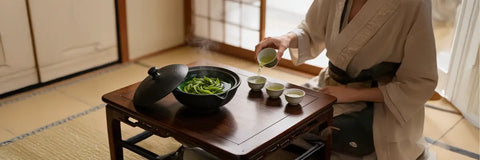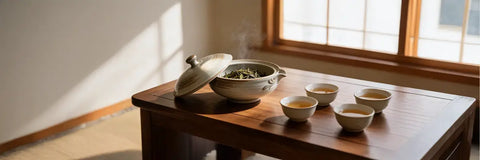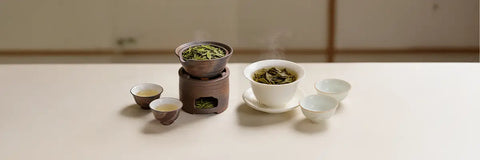
The shiboridashi vs gaiwan choice depends primarily on the tea you brew, with shiboridashi excelling at gyokuro and other Japanese green teas, while gaiwan are better suited to oolong, pu-erh, white tea, and broader multi-tea use.
The shiboridashi is Japanese in origin, flat and wide in shape, and designed to extract precise, concentrated infusions from premium green teas like gyokuro using very little water at very low temperatures. The gaiwan is Chinese, bowl-shaped, and built to handle a wide variety of teas from oolongs and pu-erhs to white teas and Chinese greens.
Both are handleless. Both use a lid-and-bowl format. But beyond that shared minimalism, these two vessels serve different purposes, suit different teas, and demand different skills to pour.
This article covers the key differences in shape, water ratio, material, pouring technique, and the teas each vessel genuinely suits, so you know exactly which one to reach for before you buy.
Shiboridashi vs Gaiwan - A Battle is Brewing
Shiboridashi vs Gaiwan: The Difference Is Tea Type and Brewing Ratio

The shiboridashi vs gaiwan decision comes down to specialization versus versatility. A shiboridashi is designed specifically for low-temperature Japanese green tea brewing, while a gaiwan can handle almost every major tea category from oolong and pu-erh to white and green tea.
Water ratio is where the difference becomes dramatic. The shiboridashi is typically used with 5 grams of leaf and just 50ml of water, a ratio designed specifically for shade-grown Japanese teas. The gaiwan uses around 5 grams with 100ml. That is already concentrated compared to everyday brewing, but the shiboridashi cuts that volume in half again.
Material adds a further dimension. Most shiboridashi are made from unglazed Japanese clay, particularly Tokoname clay, which absorbs seasoning over time and develops a mild affinity for the teas you brew in it. Gaiwan are typically porcelain or glazed ceramic intentionally neutral surfaces that do not influence flavor at all. That neutrality is a feature, not a limitation, when you want to taste the tea without interference.
Why the Shiboridashi Was Built for Japanese Green Tea
Ultra-low water ratios and what they do to flavor

Gyokuro and kabuse sencha are shade-grown for three to four weeks before harvest. That shading blocks photosynthesis, drives up chlorophyll production, and increases the concentration of L-theanine the amino acid responsible for umami sweetness and a smooth, almost thick mouthfeel. To extract L-theanine without triggering bitterness from the catechins, the water must be between 50 and 60 degrees Celsius. This is far cooler than what you would use for any other type of tea.
The flat base of the shiboridashi allows needle-shaped gyokuro leaves to spread out in a thin, even layer. At 50ml, the water barely submerges them. The result is a few sips of something dense, sweet, and intensely flavored not a full cup, but an experience. That specific extraction cannot be replicated in a gaiwan, where the deeper bowl stacks the leaves vertically and changes how the water contacts them. For those who want a Japanese teapot that sits between these two extremes in terms of size and flexibility, there is a modern option worth knowing. 👉 Origami Kyusu Teapot Folding Guide
Why gyokuro drinkers reach for it first
The shiboridashi suits multiple consecutive infusions well. After the first steep, the leaves still hold enough character for a second and third pour. Each infusion produces a slightly lighter, sweeter cup as the leaf releases the remaining amino acids. Because the shiboridashi has a spout, each pour is controlled, so you lose nothing to spillage when working with just 50ml.
The shiboridashi vs gaiwan choice becomes easy once you have tasted gyokuro prepared in each vessel. The shiboridashi's low temperature, low volume, and flat leaf bed create a silky, layered cup that the gaiwan's deeper shape and faster flow rate simply do not replicate. Nio Teas carries a Tokoname Shiboridashi and a Shiboridashi Tea Set with matching gyokuro cups if you want to start with the right combination.
What the Gaiwan Handles That the Shiboridashi Cannot
Oolong, pu-erh, and large-leaf Chinese teas
The gaiwan's depth is the feature. Ball-rolled oolongs, strip-shaped Dan Cong, and compressed pu-erh all expand considerably when wet. They need vertical room to unfurl fully and release their flavor without being compressed at the base. The flat shiboridashi has no room for that kind of leaf expansion, which makes it a poor choice for these teas regardless of skill level.
Porcelain construction also matters for aromatic teas. Oolong teas in particular shift dramatically in aroma and flavor across multiple infusions. A neutral porcelain surface preserves those aromatics without absorbing any of the volatile compounds. Brewing Dan Cong or Wuyi rock oolong in unglazed clay would allow the material to slowly take on those aromatics useful in some cases, but a problem when you want to taste each infusion cleanly and without carry-over. If you enjoy deep-steamed Japanese green teas alongside shade-grown varieties, there is a purpose-built brewing option designed precisely for that leaf. 👉 Fukamushi Kyusu: What Makes It Different for Deep Steamed Tea
Brewing flexibility and pour control
The gaiwan gives you direct, manual control over the pour speed. By adjusting the gap between the lid and the rim, you set how fast the infusion exits and how much leaf material passes through. Wider gap for large, well-expanded leaves faster pour, cleaner separation. Narrower gap for smaller or broken leaf slower pour, finer filtration. No other vessel offers this kind of in-hand adjustability.
Temperature tolerance adds another dimension to the shiboridashi vs gaiwan question and for drinkers who regularly brew full-boil teas like shou pu-erh or hojicha, a cast iron kyusu or tetsubin offers the most durable heat retention of any Japanese brewing vessel.The gaiwan handles a delicate 70-degree silver needle white tea and a full-boil shou pu-erh without any compromise. The shiboridashi, designed around the cool temperatures required for Japanese green tea, does not have the same range. If your tea shelf spans multiple origins and types, the gaiwan covers more ground.
Pouring Technique: Where the Real Skill Gap Lives
Pouring a shiboridashi
The shiboridashi vs gaiwan difference in pouring is significant. The shiboridashi is direct: after steeping, place the lid back on and tilt the spout toward the cup. A steady wrist movement produces a controlled, consistent stream. Because gyokuro brews at 50 to 60 degrees, the vessel itself stays cool enough to hold comfortably four fingers under the base, thumb on the lid. First-time users typically nail this on their first attempt.
The built-in notches or clay mesh near the spout keep fine needle leaves inside the pot without any manual adjustment. That removes the single biggest challenge that the shiboridashi vs gaiwan comparison usually highlights for beginners, the gaiwan requires precision in that lid gap that takes practice to develop. For a traditional clay option with a distinctive rustic finish, the Brown Shigaraki Shiboridashi Set pairs a wide flat shiboridashi with matching cups an ideal starting point for gyokuro brewed the traditional way. For a cleaner aesthetic that highlights the pale color of premium gyokuro liquor, the White Shigaraki Shiboridashi Set offers the same precision brewing in a lighter clay finish.
Pouring a gaiwan
Pouring a gaiwan correctly takes a few sessions to learn. You hold the bowl between two fingers on opposite sides of the rim, press the lid in place with a third finger or knuckle, and tilt from the wrist. The base of the gaiwan gets hot first; touching it while brewing at high temperatures will burn your fingers. Correct finger placement avoids the base entirely, which feels counterintuitive at first.
Once the technique clicks, the gaiwan becomes very fast and precise. You can pour a full 100ml in two or three seconds with the right wrist motion. But that speed only comes with practice. For someone new to this style of brewing, the shiboridashi vs gaiwan decision sometimes comes down to which learning curve they are willing to work through.
Shape, Capacity, and How Tea Leaves Behave in Each Vessel
In the shiboridashi vs gaiwan comparison, the flat, wide profile of the shiboridashi is purpose-built for Japanese needle-shaped teas. Gyokuro and sencha leaves are elongated and thin; they lie flat across the base in an even layer and make consistent contact with the water from the first second of steeping. There is no clumping, no stacking, no uneven extraction.
The gaiwan's bowl shape creates a different dynamic. Needle-shaped leaves tend to bunch vertically and make uneven contact with the water, which leads to a less consistent extraction. This is not a problem for rolled or strip-cut teas that expand naturally and separate in the bowl. For a tea like Dan Cong or gong fu oolong, the bowl shape is actually ideal. The flat, wide profile of the shiboridashi is purpose-built for Japanese needle-shaped teas a design principle shared by the flat kyusu, another low-profile vessel that promotes even leaf distribution and consistent extraction for premium Japanese green teas.
In volume terms, most gaiwans sit between 80 and 150ml. The shiboridashi holds around 50ml. That gap reflects the intended purpose the shiboridashi is a precision tool designed around a single category of rare, high-grade tea. The gaiwan is a general instrument for daily use across many teas. Our teaware collection includes both vessels alongside detailed specifications if you want to compare sizes before buying.
When a Shiboridashi Makes More Sense Than a Gaiwan

If gyokuro, kabuse sencha, or other shade-grown Japanese teas make up most of your collection, the shiboridashi vs gaiwan decision is already made for you. No other vessel extracts this leaf type at this temperature and ratio as effectively. The gaiwan can technically brew gyokuro, but the bowl shape, higher water volume, and neutral surface do not produce the same thick, layered, umami-forward cup.
The shiboridashi also wins on ease of use. The spout removes the guesswork from pouring. You do not need to manage a lid gap under heat. The cool brewing temperature keeps the vessel comfortable to hold. For someone just starting to explore premium Japanese green tea, the shiboridashi is the more accessible starting point by a clear margin. For drinkers choosing between the shiboridashi and another handleless Japanese vessel, a comparison of the shiboridashi vs hohin explains how these two purpose-built tools differ in shape, pour, and optimal tea type.
The gaiwan is the better choice when variety matters. One gaiwan handles oolong, pu-erh, white tea, and Chinese green tea with equal confidence. If your collection spans multiple countries and processing styles, the gaiwan gives you more daily range. If you want to start with the right combination, browse Nio Teas' full shiboridashi collection, which includes Tokoname clay options and matching gyokuro cup sets. For a closer look at how all major Japanese brewing vessels compare, our ultimate guide to Japanese teapots covers the full range of options from kyusu to shiboridashi in one place.