

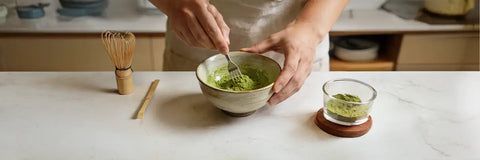
How long to whisk matcha is the question that most directly separates a smooth, frothy bowl from a flat, gritty one. The answer is 20 to 30 seconds of continuous, wrist-driven strokes in a W or M pattern.
That window is reliably enough for a quality chasen to build microfoam and fully dissolve the powder.
If you've ever wondered how long should I whisk matcha to get proper foam, the answer starts with understanding these fundamentals - your matcha grade, water temperature, powder-to-water ratio, and whisking technique all affect how quickly and how well the foam forms.
This article covers exactly what to expect during those seconds, how to read visual cues that tell you when you are done, and the mistakes that extend whisking time unnecessarily.
Let's get started!
How Long to Whisk Matcha: 20 to 30 Seconds

For a standard bowl of usucha, or thin matcha, how long to whisk matcha is 20 to 30 seconds — this directly answers the common beginner question: how long do I whisk matcha for best results.
At that mark, a well-made chasen will have aerated the liquid fully and produced a dense, creamy layer of microfoam across the surface.
At the 10-second point you will notice large bubbles forming. These signal early aeration but are not the target. Keep whisking until those bubbles tighten into much finer ones, typically arriving between 20 and 30 seconds.
For koicha, the thicker preparation used in formal tea ceremony, the approach is entirely different. The powder is folded slowly into a smaller volume of water rather than whisked, which takes around 60 seconds and produces no foam at all.
If your goal is a milk-based drink rather than a traditional bowl, the whisking mechanics shift slightly. Explore Nio Teas' matcha latte recipes for preparation variations that suit a latte format.
If you are new to the world of matcha, it helps to understand what sets it apart from other green teas before picking up the whisk. 👉 What is Matcha? Complete Matcha Encyclopedia
What Happens to the Matcha During Those 30 Seconds
The first few strokes wet all the powder and break apart any surface clumps. The liquid at this stage is still uneven, with denser pockets at the bottom of the bowl.
From around 5 to 15 seconds, air enters the mixture in increasing quantities. The liquid starts to lighten slightly and large, unstable bubbles appear at the surface. If you stopped here, those bubbles would collapse within a few seconds.
Between 15 and 30 seconds, the whisk breaks those large bubbles down into finer ones. True microfoam forms during this phase. The surface shifts from rough and bubbly to a tighter, more uniform layer, and the colour visibly brightens.
Understanding how long to whisk matcha means reading these phases, not just watching a clock. The 20 to 30 second guideline assumes steady, correct technique from the first stroke.
Stopping too early leaves large bubbles that collapse before you can lift the whisk. Stopping at the right moment gives foam that holds long enough to drink slowly and appreciate the texture.
How to Tell When Your Matcha Is Whisked Enough

Watch the Bubble Size Change
Bubble size is the clearest visual signal. When the surface shows fine, tightly packed bubbles rather than large, scattered ones, you have built proper microfoam. This is the texture that gives good matcha its creamy mouthfeel and prevents the chalky aftertaste of under-whisked powder.
Large bubbles after 30 seconds signal a problem beyond timing, typically the wrong water temperature, unsifted powder, or a worn chasen. Knowing how long to whisk matcha will not fix those underlying issues on its own.
The Drip Test After Lifting the Chasen
Lift the chasen slowly straight out of the bowl. If the liquid runs off the tines in a thin, fast stream, the matcha needs more time. If it drips slowly and the surface holds its shape briefly, the foam is ready.
A secondary check is to drag the whisk lightly across the surface as you finish. A well-whisked bowl offers slight resistance, as if the liquid has some body to it, rather than parting like plain water.
Mistakes That Make Whisking Take Longer Than Necessary
Water Above 80° Degrees and below 70°
Water above 80°C damages the amino acids and catechins in matcha before whisking even begins. The result is a bitter, flat bowl where foam either does not form well or collapses almost immediately, regardless of how long to whisk matcha you attempt.
Use water between 70 and 80°C. At that temperature the powder dissolves cleanly, foam forms within the expected 20 to 30 seconds, and the natural sweetness of the matcha comes through without heat interference. If you find standard ceremonial matcha difficult to dissolve consistently, Matcha Latte Powder, a purpose-blended format may suit your routine better.
Skipping the Sifting Step
Unsifted matcha contains micro-clumps that resist full dissolution even with extended whisking. You can whisk with perfect technique and still find gritty specks at the bottom or ragged chunks disrupting the foam.
Sifting takes about 10 seconds and eliminates this entirely. It is the fastest single change you can make to reach smooth, properly aerated matcha in the standard 20 to 30 second window.
Using a Circular Rather Than W-Pattern Motion
A circular stirring motion moves the liquid around the bowl without effectively incorporating air. For how long should you whisk matcha to actually matter and to answer how long should I whisk matcha effectively - the motion needs to be a rapid back-and-forth W or M pattern near the surface of the liquid.
This horizontal action agitates the surface layer where air contact is highest. Switching from circular to W-pattern whisking often cuts foam formation time visibly, sometimes from 40 seconds down to 20 without any other changes.
Matcha Quality Sets the Ceiling on What Technique Can Achieve

Even correct technique with precise timing cannot fully compensate for low-grade matcha. Ceremonial-grade matcha processed from shade-grown tencha contains higher concentrations of L-theanine and amino acids that directly support foam stability and a clean, smooth texture.
Older or lower-grade matcha oxidises over time, losing both colour and foaming ability. No matter how long to whisk matcha you invest, oxidised powder produces thinner, less cohesive foam that collapses quickly and carries a dull, greenish-yellow colour rather than the bright, vivid green of fresh matcha.
For a deeper look at the full preparation process, including how to clean and maintain your whisk properly, the Nio Teas complete matcha whisk guide takes you through each stage in detail.


Comments (0)
There are no comments for this article. Be the first one to leave a message!